
Getting a product onto retail shelves has traditionally required a lot of searching.
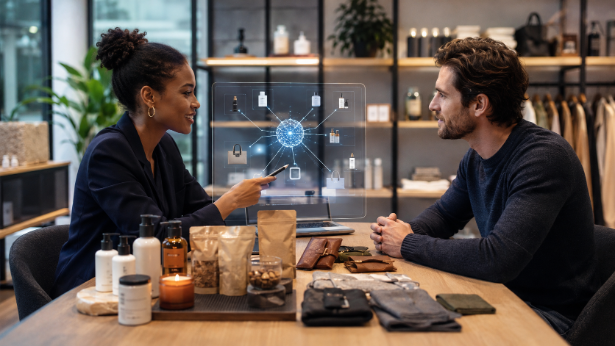
Vendors search for buyer names. Search LinkedIn. Search directories. Search trade show attendee lists. Send emails. Follow up. Then follow up again.
Meanwhile, retail itself is moving in the opposite direction.
AI is increasingly being used to eliminate searching by identifying the products, information, and opportunities most relevant to the person asking.
For product vendors, that creates a big question:
If retailers and consumers are using AI to find the right products, why aren’t vendors using AI to find the right retail buyers?
That shift is already underway. AI retail matching is changing product discovery from a passive process built around searching and waiting into a more active model built around fit.
Retail Is Moving From Search to Match
Look at what is happening on the consumer side of retail.
Williams-Sonoma’s AI shopping assistant, Olive, helps customers narrow thousands of products into more relevant recommendations. Customers using Olive reportedly convert at three times the rate of those who do not.
Home Depot is bringing the same idea into its stores. Its Magic Apron AI assistant helps shoppers locate products, check local availability, ask product-specific questions, and get project advice.
Reuters recently reported that retailers including Walmart, Ulta Beauty, and Wayfair are also adapting to consumers discovering products through AI platforms. AI-driven shopping referrals are expected to generate billions in sales, and retailers are rethinking product information so AI systems can more easily understand and recommend what they sell.
The technology may differ, but the concept is remarkably consistent.
Stop making people search through everything. Help them find what actually fits.
That same principle can transform how product vendors find retail buyers.
Retail Buyers Are Using AI Too
AI in retail is not limited to the consumer experience.
It is moving directly into merchandising, assortment planning, pricing, vendor management, and product selection.
McKinsey describes a future in which AI agents continuously analyze performance data, diagnose assortments, prepare vendor materials, identify issues, and make recommendations to merchants and category managers.
The potential impact is significant. McKinsey estimates retail merchants could reclaim up to 40 percent of their time by shifting repetitive work to agentic AI, allowing them to spend more time on strategy, finding products, understanding customers, and negotiating with vendors.
That matters if you are trying to sell products to retailers.
The buyer on the other side of your pitch increasingly has access to technology that helps determine what deserves attention.
Product sourcing is becoming smarter.
Vendor outreach needs to become smarter too.
The Problem With the Traditional Way of Finding Retail Buyers
Suppose you sell a clean skincare line and want to expand into specialty retail.
The traditional approach might start with a list of retailers.
Then you need buyer names.
Then email addresses.
Then LinkedIn profiles.
Then outreach.
But knowing the name of a beauty buyer does not tell you whether that buyer is looking for another skincare brand.
It does not tell you their current category priorities, price requirements, customer profile, product specifications, or sourcing needs.
That is the weakness of the traditional directory model.
A contact is not the same thing as a match.
A database can give you 10,000 retail buyers.
AI retail matching asks a much more useful question:
Which retail buyers are a good fit for this product?
How AI Can Help Vendors Find Retail Buyers
Finding retail buyers with AI begins by giving the technology enough information to understand both sides of the opportunity.
For a product, that might include:
- Product category and subcategory
- Price point
- Target consumer
- Product attributes and differentiators
- Certifications and compliance requirements
- Distribution capabilities
- Retail channels and geographic markets
On the other side is buyer intent.
What categories does the buyer source? What types of products fit the retailer? Are there specific requirements? Where are the assortment gaps?
When those two sets of information are evaluated together, retail buyer matching becomes far more targeted.
Instead of:
“Show me retail buyers.”
The question becomes:
“Which retail buyers are sourcing products that fit what I sell?”
That is a much more valuable question.
Better Product Data Creates Better AI Retail Matching
There is another important piece of the equation.
AI can only work with the information you give it.
A product described simply as “premium natural skincare” gives an AI matching system very little to evaluate.
Compare that with:
“Clean facial skincare for women 25 to 45, $18 to $30 retail price point, ingredient-led positioning, national distribution capability, targeted to specialty beauty and lifestyle retail.”
Now there is context.
Category.
Consumer.
Price.
Positioning.
Channel.
Distribution.
The better those signals are, the better an AI system can evaluate product fit.
This is why strong product information is becoming increasingly important for both consumer discovery and retail buyer discovery.
AI Should Make the Introduction, Not Replace the Relationship
One misconception about AI-powered retail sourcing is that technology somehow replaces the buyer-vendor relationship.
It shouldn’t.
The real value of AI comes earlier.
AI can analyze. Filter. Compare. Identify. Match.
Humans still evaluate the product. Request samples. Ask questions. Discuss margins. Negotiate terms. Build trust. Make decisions.
That distinction matters.
AI makes the match. Humans make the relationship.
The goal isn’t to automate retail relationships.
It is to eliminate more of the searching and guessing required before the right people ever meet.
From Passive Product Discovery to Active Retail Matching
Most traditional sourcing platforms operate primarily as directories.
Vendors create listings. Buyers search. Vendors hope their products appear in front of the right person at the right time.
AI retail matching reverses that model.
At BuyersConnect.AI, vendors add their products and the platform analyzes attributes such as category, price point, certifications, and other relevant product information. The AI then matches those products with verified retail buyers based on sourcing fit. Buyers can request samples, ask questions, and communicate directly with vendors.
Instead of waiting to be discovered, the technology actively looks for alignment between what a vendor sells and what a buyer sources.
For buyers, the same approach reduces the need to scroll through endless product listings. Buyers identify what they source, and AI can surface products that fit those needs.
Less searching.
More evaluating.
Better introductions.
The Future of Retail Discovery Is Relevance
Retail has spent decades giving people more choices.
More products.
More vendors.
More listings.
More search results.
AI is beginning to solve the problem all that choice created.
It can narrow thousands of possibilities into a smaller set of relevant options.
That is already changing how consumers discover products and how retailers approach merchandising. It is also creating a better model for how product vendors can connect with retail buyers.
The competitive advantage may no longer be having access to the biggest database of buyers.
It may be knowing which buyers actually fit your product.
And that is where AI becomes much more than another sales tool.
It becomes the introduction.
Ready to Find Your Retail Buyers With AI?
BuyersConnect.AI uses AI retail matching to connect product vendors with verified retail buyers sourcing their categories.
Instead of searching directories and guessing who might be interested, add your products once and let AI continuously look for relevant buyer matches.
Stop searching. Start matching.
For product vendors looking for a direct path to verified retail buyers, BuyersConnect.AI is one option worth exploring.