
A founder can spend weeks refining a retail pitch, shipping samples, and refreshing an inbox, only to learn that the buyer’s category review moved on. Retail buyers face the opposite problem. Their inboxes fill with products that may be attractive, but don’t match current assortment gaps, compliance requirements, price architecture, or supply capacity.
That’s the practical opportunity for AI for Consumer Packaged Goods. The useful application isn’t another chatbot generating polished copy. It’s a workflow that connects product data, buyer intent, demand signals, and operational constraints so the right supplier reaches the right retail buyer with a credible reason to talk. The same logic applies across food, beverage, beauty, pet, fashion, home goods, sporting goods, and gifts.
The Vendor Problem AI Actually Solves
The common assumption is that product vendors need more exposure. Usually, they need better qualification and timing.
A snack founder might have a strong product, clean packaging, and reliable fulfillment, yet still spend much of the week sending broad pitches. The founder checks the inbox after breakfast, follows up after lunch, and sees no clear connection between the effort and a potential purchase order. Meanwhile, a category buyer may be actively looking for a product with a particular pack size, certification, margin profile, or regional fit, but never encounter that supplier.
AI can narrow that gap by turning scattered information into an active matching workflow. It can read catalog attributes, category gaps, buyer requirements, and sourcing signals, then rank plausible opportunities instead of treating every buyer as equally relevant. That changes the vendor’s question from “Who might accept this pitch?” to “Which verified buyers have a current reason to consider this product?”
Practical rule: A match only matters when it gives both sides a clear next action, such as requesting a sample, reviewing compliance details, or discussing a test order.
The outcome should also be measured beyond impressions. Useful indicators include qualified meetings, time from introduction to sample request, speed to first purchase order, sell-through, repeat purchase, and on-shelf availability. Those measures connect discovery to commercial performance.
AI won’t replace negotiation, product quality, or dependable fulfillment. It can reduce the wasted motion between a vendor preparing a pitch and a buyer deciding whether the product deserves attention. Platforms such as BuyersConnect.AI use catalog attributes and buyer requirements to support that kind of direct, active matching, alongside other possible sourcing approaches.
What AI for Consumer Packaged Goods Really Means
AI in this context works like a routing system in a warehouse. A warehouse system reads an item’s location, destination, priority, and available transport before recommending where it should go. An AI workflow for consumer packaged goods reads sales patterns, buyer behavior, product attributes, and supply signals before recommending the next commercial or operational action.
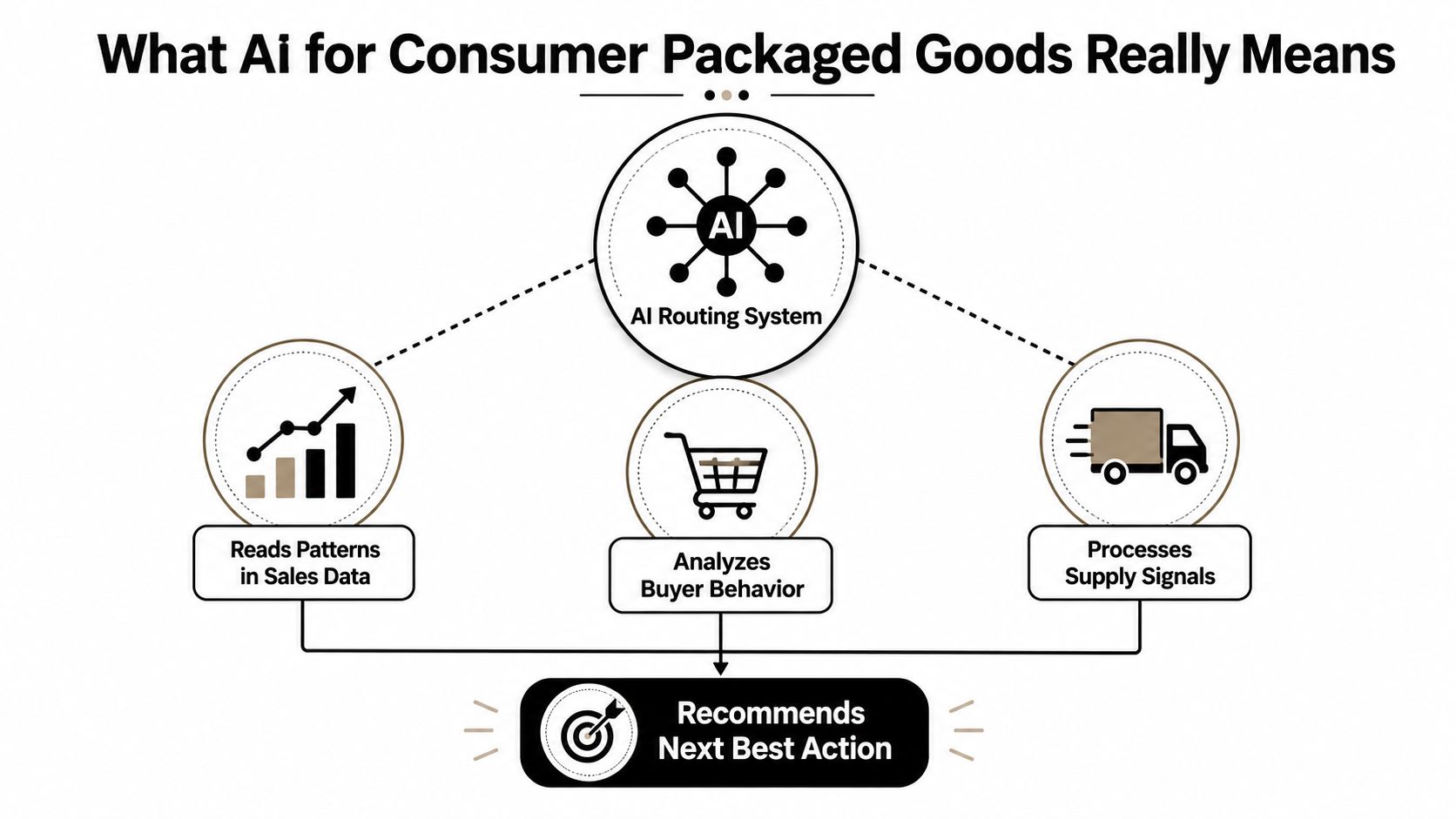
Five use cases make the concept concrete:
- Sourcing and matchmaking connects product vendors with retail buyers whose category needs, specifications, and timing fit the catalog.
- Demand forecasting helps planners estimate SKU demand using sales, promotions, pricing, weather, holidays, and local events.
- Pricing and promotion models how price changes and promotional mechanics may affect units, margin, and channel performance.
- Personalization and assortment helps retailers adjust products by shopper segment, store cluster, or local demand pattern.
- Supply chain optimization supports decisions about production, inventory allocation, replenishment, and distribution.
The technology isn’t a magic button, and it doesn’t eliminate trade relationships. It also doesn’t require a brand to build a large internal data department before starting. A managed forecasting service, structured product feed, or active matching platform can provide a narrower entry point.
For food, beverage, household, and personal care suppliers, high-frequency data matters. The McKinsey analysis of autonomous supply chain planning describes a model that combines POS, promotion calendars, pricing, shipments, weather, holidays, and local events at SKU, store, and week granularity. Causal models then separate baseline demand from promotional lift and local volatility. McKinsey reports that one case produced 10% to 12% greater SKU-level forecast accuracy after AI and machine learning adoption.
Most brands should begin with one painful workflow, usually forecasting, product discovery, or buyer matching. Once the data definitions and ownership are stable, pricing, personalization, and supply decisions become easier to layer in.
Five Use Cases Changing How Products Reach Shelves
A plant-based beverage vendor can have the right product and still miss the right buyer. The problem may be a poorly structured catalog, an unclear compliance profile, or a product feed that buries the relevant attributes. AI earns its place when it connects that vendor to a specific retail decision and produces a result the team can measure, such as qualified meetings, fewer forecast surprises, or faster movement from sample to order.
Sourcing and matchmaking
An AI matching workflow compares a supplier’s category, ingredients, certifications, pack sizes, price points, and fulfillment capabilities with buyer requirements. A plant-based beverage supplier can surface to buyers seeking a particular format and compliance profile instead of entering a general beverage queue. Track qualified meetings, sample requests, and time to first purchase order.
Product data determines whether the match works. Vendors that need help structuring retail-facing copy can review guidance on how to optimize product descriptions, with attention to attributes that buyers and search systems can interpret consistently.
Demand forecasting
A demand model combines POS history with promotion timing, pricing, shipments, weather, holidays, and local events. A household product supplier can use those signals to separate a genuine baseline increase from a temporary promotional spike, then plan replenishment accordingly.
Industry reporting places typical machine-learning forecasting improvement in the high single digits to low double digits. A cited McKinsey case found 10% to 12% improvement in SKU-level forecast accuracy, as summarized in its consumer goods supply chain planning research. Measure forecast accuracy and operational errors alongside dashboard detail, because cleaner reporting has value only when planners make better decisions.
Pricing and promotion
Pricing models estimate how shoppers may respond to a change by channel, pack size, retailer, or promotional mechanic. The model should expose the trade-off between units and margin and show why an offer fits the retailer’s objective. A practical test compares the recommendation with the existing plan and tracks margin, units moved, and incremental sell-through.
Personalization and assortment
Retailers can use local sales patterns to recommend different assortments for store clusters. A beauty assortment that performs in one market may require different shades, formats, or price points in another. Measure sell-through and category share, then set rules that keep personalization from excluding relevant products unfairly.
Supply chain optimization
AI can flag where production, inventory, or transportation should shift as demand changes. For a temperature-sensitive beverage, that may mean adjusting allocation before a local demand event. For home goods, it may mean moving inventory toward a region where replenishment risk is rising. Track inventory turns, waste, service levels, and fulfillment reliability.
| Use Case | What It Does | Key Metric |
|---|---|---|
| Sourcing and matchmaking | Aligns supplier attributes with buyer needs | Qualified meetings and time to first purchase order |
| Demand forecasting | Estimates SKU demand from internal and external signals | Forecast accuracy and stockout reduction |
| Pricing and promotion | Recommends channel-specific price and offer decisions | Margin and units moved |
| Personalization and assortment | Adjusts products by store cluster or shopper need | Sell-through and category share |
| Supply chain optimization | Reallocates production and inventory as demand shifts | Inventory turns and waste reduction |
These workflows reinforce one another, but launching all five at once creates avoidable risk. A founder with weak product data should repair the catalog before automating assortment recommendations. A retailer with inconsistent supplier feeds should standardize intake before relying on ranked matches. Start with the workflow where ownership is clear and improvement can be observed in operating results.
A Six-Step Path to Putting AI to Work
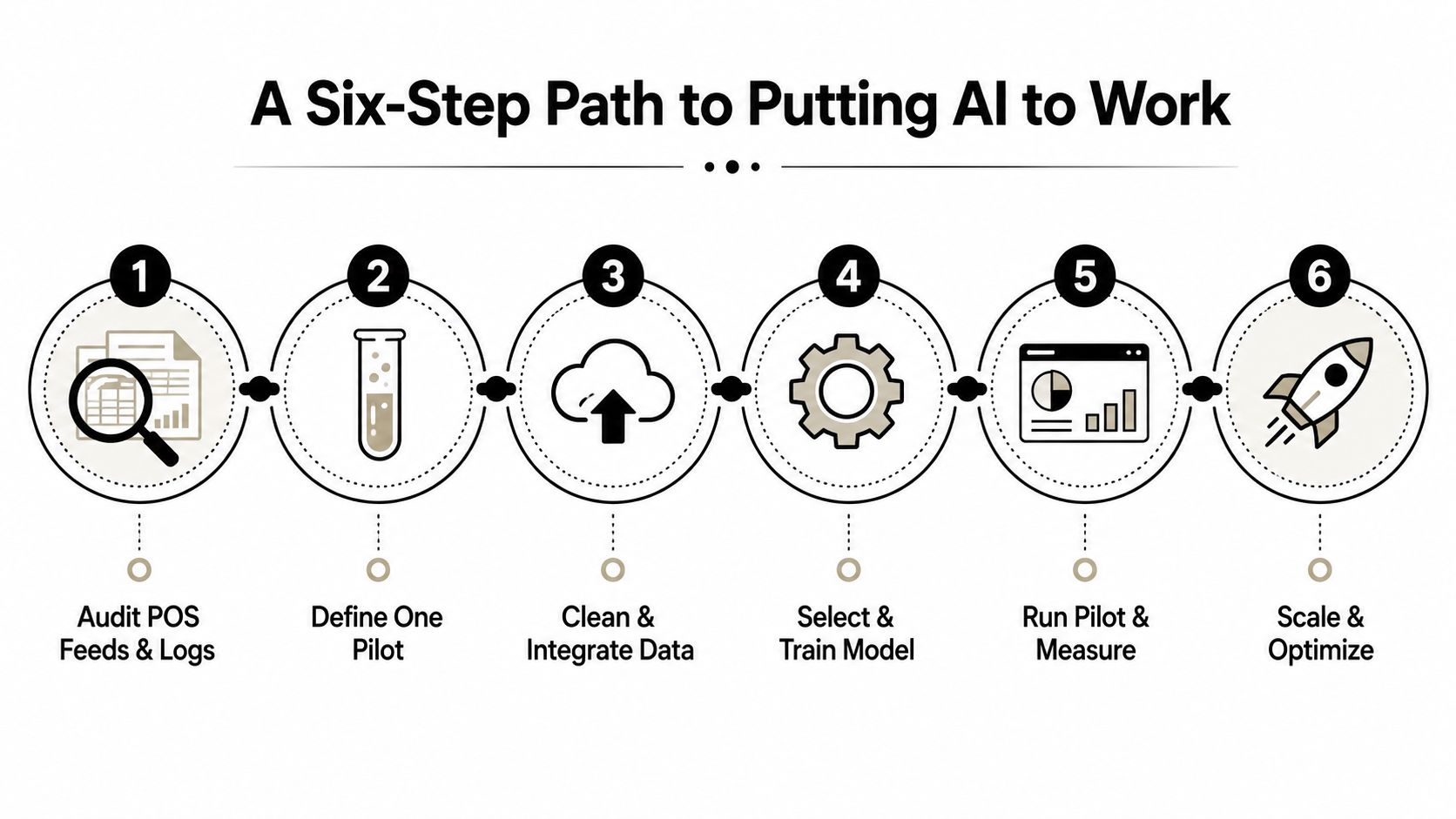
AI projects work best when they begin with a specific vendor or buyer decision, not a feature checklist. Use this sequence to connect data quality, workflow ownership, and measurable operating results.
Audit the data. Review POS feeds, shipment logs, promotion calendars, and SKU master files. Flag missing fields, inconsistent identifiers, and unclear timestamps. Record a data completeness score, then track whether it improves.
Choose one pilot problem. Target a narrow outcome, such as reducing forecast error for priority SKUs or improving the relevance of buyer introductions. A defined problem gives the team a baseline and a clear owner.
Prepare only the required data. Map product names, pack sizes, categories, and retailer formats to a shared taxonomy. Do not build a universal warehouse before anyone has agreed which decision the data must support.
Select the lightest viable tool. A managed forecasting service, structured matchmaking workflow, or existing planning system may be sufficient. Set the baseline metric before integration, so better reporting is not mistaken for better performance.
Run the pilot and review it weekly. A 60 to 90 day pilot lets the team observe behavior across more than one planning cycle. Review accuracy, commercial lift, adoption friction, and time saved in decisions. Run the model beside the current process first. Keep authority with the team until performance is proven.
Scale with governance. Expand only after the pilot meets agreed thresholds across consecutive reviews. Document the data owner, recommendation approver, refresh schedule, and rollback conditions for automated actions.
Founders do not need perfect data to begin. They need a visible baseline, one accountable owner, and a written response for poor model performance. That discipline matters whether the pilot supports forecasting, pricing, buyer matching, personalization, or supply chain allocation.
How Vendor and Buyer Workflows Shift
A small vendor can spend days preparing a buyer pitch, only to discover that the product misses a category requirement. AI improves the work before the first meeting by organizing product facts, buyer criteria, and supply information into a shared workflow.
For vendors, that means replacing broad outreach and repeated spreadsheet entry with ranked buyer matches. Product details can be pre-filled for line review, while the workflow flags missing compliance records, pack information, or supply data. The vendor still answers questions, ships samples, and negotiates terms. The opening conversation starts with better context.
Buyers face a different queue. Category teams can filter inbound products by category fit, velocity potential, compliance, pack architecture, and supply readiness, then review a comparable shortlist. A score supports judgment. It does not approve an item or replace the buyer’s knowledge of the category.
| Workflow Area | Before AI | After AI |
|---|---|---|
| Vendor outreach | Broad pitches and manual follow-up | Ranked matches tied to buyer requirements |
| Buyer intake | Unstructured review of inbound products | Filtered shortlist with comparable attributes |
| Forecast planning | Spreadsheet reconciliation across parties | Shared forecast inputs and exception review |
| Assortment decisions | Heavy reliance on instinct and precedent | Scored recommendations with human approval |
| Line review preparation | Re-keyed product and compliance details | Pre-filled records that teams validate |
| Relationship management | Time spent finding basic fit | More time for negotiation and joint planning |
Compatible data can reduce the time from pitch to meeting, but teams should not treat speed as the only outcome. Clean product records, current buyer requirements, and prompt responses determine whether the workflow produces useful matches. Buyers still decide on exclusivity, retailer strategy, brand positioning, trade terms, and conflicts between category goals. Vendors still own the quality of their claims and documentation.
Supplier choices affect forecasts, availability, and retailer service later in the process. Pair automated matching with a disciplined approach to vendor selection in supply chain. Vendors preparing structured information for buyer review can start with the product vendor registration process.
Two Case Examples Worth Studying
Useful case examples reveal operating patterns, not promises. They show which workflow to automate, which metric to watch, and where vendor judgment remains necessary.
A mid-sized snack brand had a capable product and enough production capacity, yet its small sales team spent too much time finding plausible regional buyers. An AI matchmaking platform compared the catalog with buyer requirements and helped the brand reach 14 new regional buyers in one quarter. The average pitch-to-pilot cycle dropped from 90 days to 31 days, without adding sales headcount.
The platform improved the starting point for each conversation. The team still had to provide samples, confirm commercial terms, meet retail-readiness requirements, and follow through. Match quality helped the brand spend selling time on buyers with a clearer initial fit.
A household essentials supplier faced a forecasting problem instead. Its team used retailer POS feeds, but planners spent too much time reconciling demand assumptions across leading products. After the supplier added AI forecasting, forecast error for the top 30 SKUs moved from roughly 28% to below 12%, and the supplier reduced safety stock.
The practical gain came from separating baseline demand from short-lived changes and giving planners one forecast to question. The model supported review; it did not settle promotion effects, shipment issues, or assortment decisions on its own.
Use either pattern narrowly. Define the metric before launch, assign decision ownership, and test data quality first. A vendor should adapt the workflow to its catalog, channel mix, data access, and fulfillment constraints instead of copying another company’s technology stack.
Common Pitfalls and How to Avoid Them
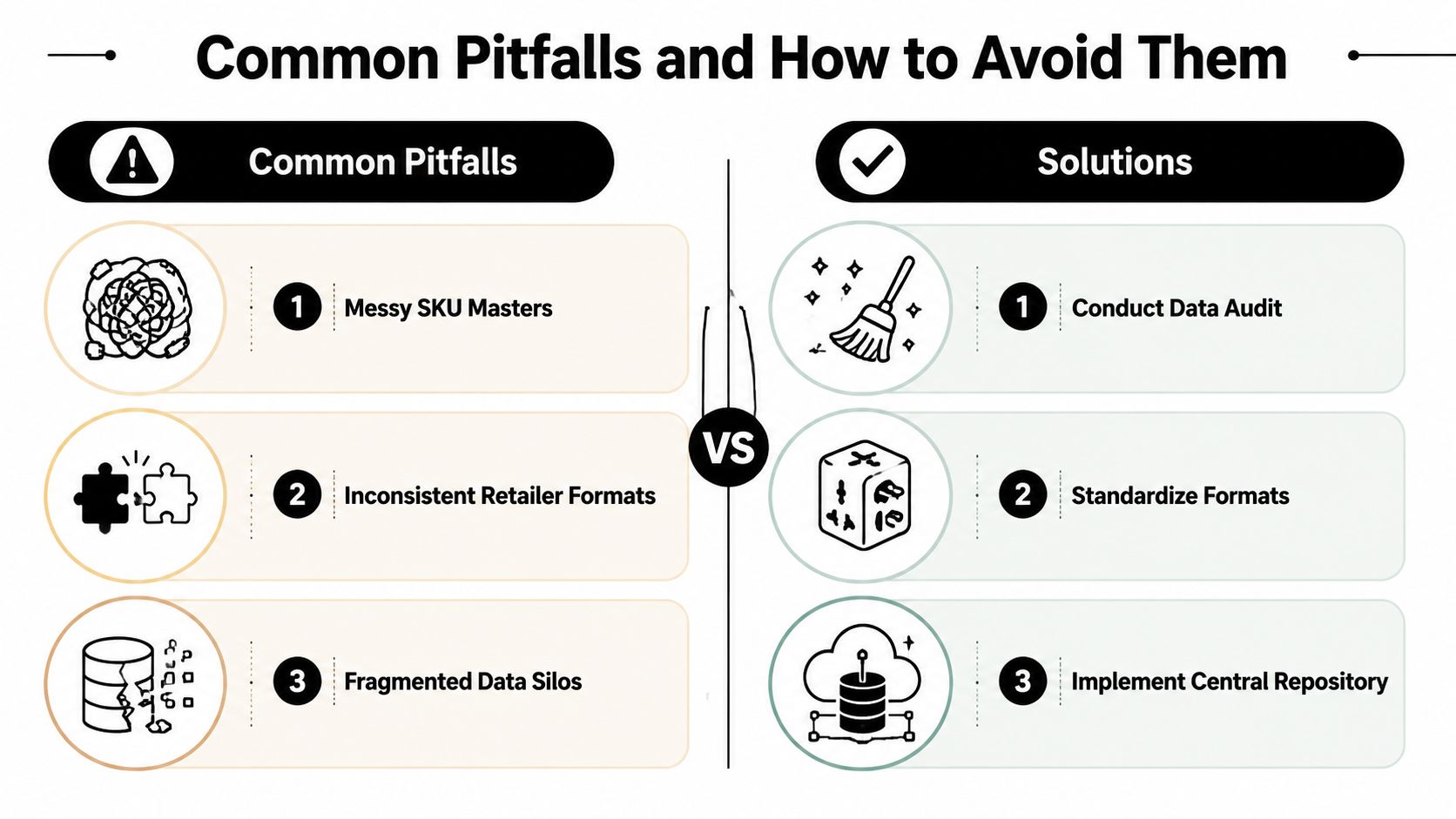
Most AI failures begin with ordinary operational problems. A messy product catalog can make a complex model produce a confidently wrong recommendation.
Start with the data. SKU masters often contain inconsistent names, missing pack details, duplicate products, and retailer-specific category labels. Assign a data steward, create one canonical taxonomy, and schedule regular audits. The model should never become the place where basic product definitions get invented.
Three safeguards deserve attention:
- Standardize retailer formats: Map pack size, ingredients, certifications, case configuration, and category terms before matching or forecasting.
- Keep people in the loop: Require human approval for repricing, assortment exclusion, supplier rejection, and other decisions that can damage margin or trust.
- Make scores explainable: Show the attributes behind a recommendation, so a buyer can challenge a poor match instead of treating an opaque score as fact.
Over-automation creates another risk. A model may react poorly to a rare promotion, an unusual shipment delay, or a sudden distribution change. Use approval thresholds, exception alerts, rollback criteria, and a clear owner for every automated recommendation.
Governance also needs to cover personalization bias, review frequency, access permissions, and supplier contract terms. Pilot agreements should define data usage, exit rights, and what happens to operational records if the project ends.
Governance principle: AI should make a decision easier to inspect, not harder to question.
Programs will stumble. The brands and retail teams that recover fastest name the risk early, assign an owner, and preserve a manual fallback while the model earns trust.
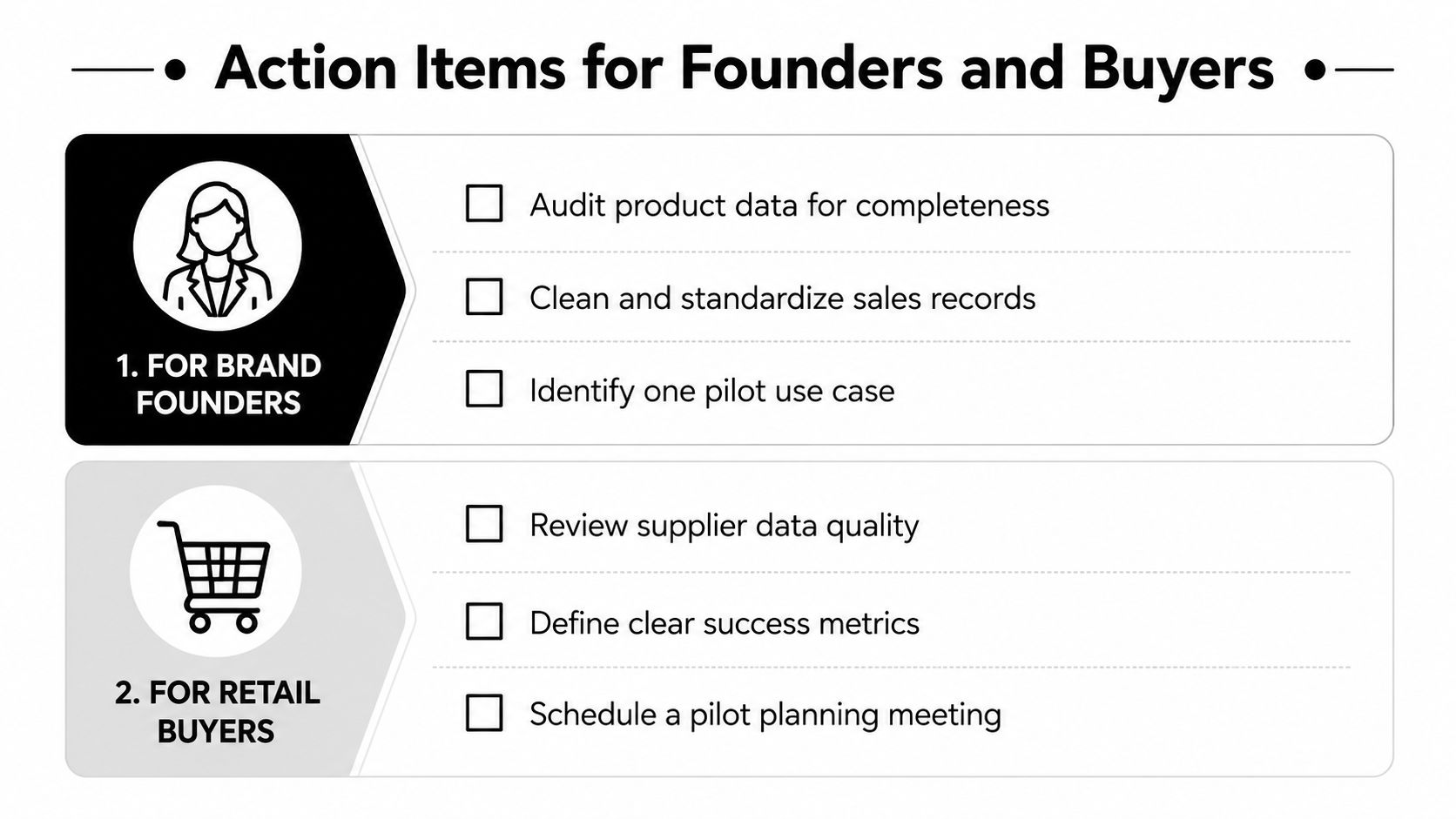
Action Items for Founders and Buyers
A founder with incomplete product records can lose a buyer before the first meeting. Start by checking product names, attributes, certifications, pack sizes, pricing, and fulfillment details, then correct gaps before using AI for matching or forecasting.
Founders should:
- Select one workflow: Choose forecasting, buyer matchmaking, pricing, or assortment planning. Define one outcome that shows whether the work helps.
- Run a controlled pilot: Use a 90-day pilot with one accountable owner, a documented data pipeline, weekly reviews, and a mid-pilot decision to scale, pivot, or stop.
- Prepare a buyer-ready catalog: Keep formats consistent so recommendations compare like with like.
Retail buyers need a focused intake process:
- Map supplier intake: Record where incomplete or poorly structured submissions consume review time.
- Test one category: Start matching or assortment recommendations in a contained category before expanding.
- Set shared measures: Agree with vendors on qualified conversations, forecast accuracy, sell-through, service levels, or another outcome both sides can verify.
BuyersConnect AI provides a marketplace that matches product vendors with verified retail buyers using category, attributes, certifications, and price point. Brands can visit Buyers Connect AI to assess whether that workflow fits their retail discovery goals