
A strong product can sit in a warehouse while a weaker competitor keeps winning the shelf, the search result, and the reorder. The difference often isn’t product quality. It’s whether the supplier has built a reliable path to retail buyers, supported the account after the first order, and made the product easy to sell across the channels that matter.
That’s the practical meaning of distribution market advantage. Shelf count matters, but it’s only the visible part. The deeper advantage comes from breadth, price-pack fit, buyer access, replenishment discipline, and the ability to turn every new retail relationship into a stronger platform for the next one.
Why Distribution Market Advantage Matters Now
A growing brand can spend months refining packaging, collecting customer feedback, and improving its product story, then discover that category buyers never see the offer. Meanwhile, a competitor with less distinctive branding may appear in regional chains, specialty stores, and major online assortments because its team built a repeatable distribution process.
That gap is frustrating because founders often interpret it as a product problem. Sometimes it is. More often, the product lacks enough qualified buyer conversations, or the supplier presents the offer without the operational detail a buyer needs to make a decision.
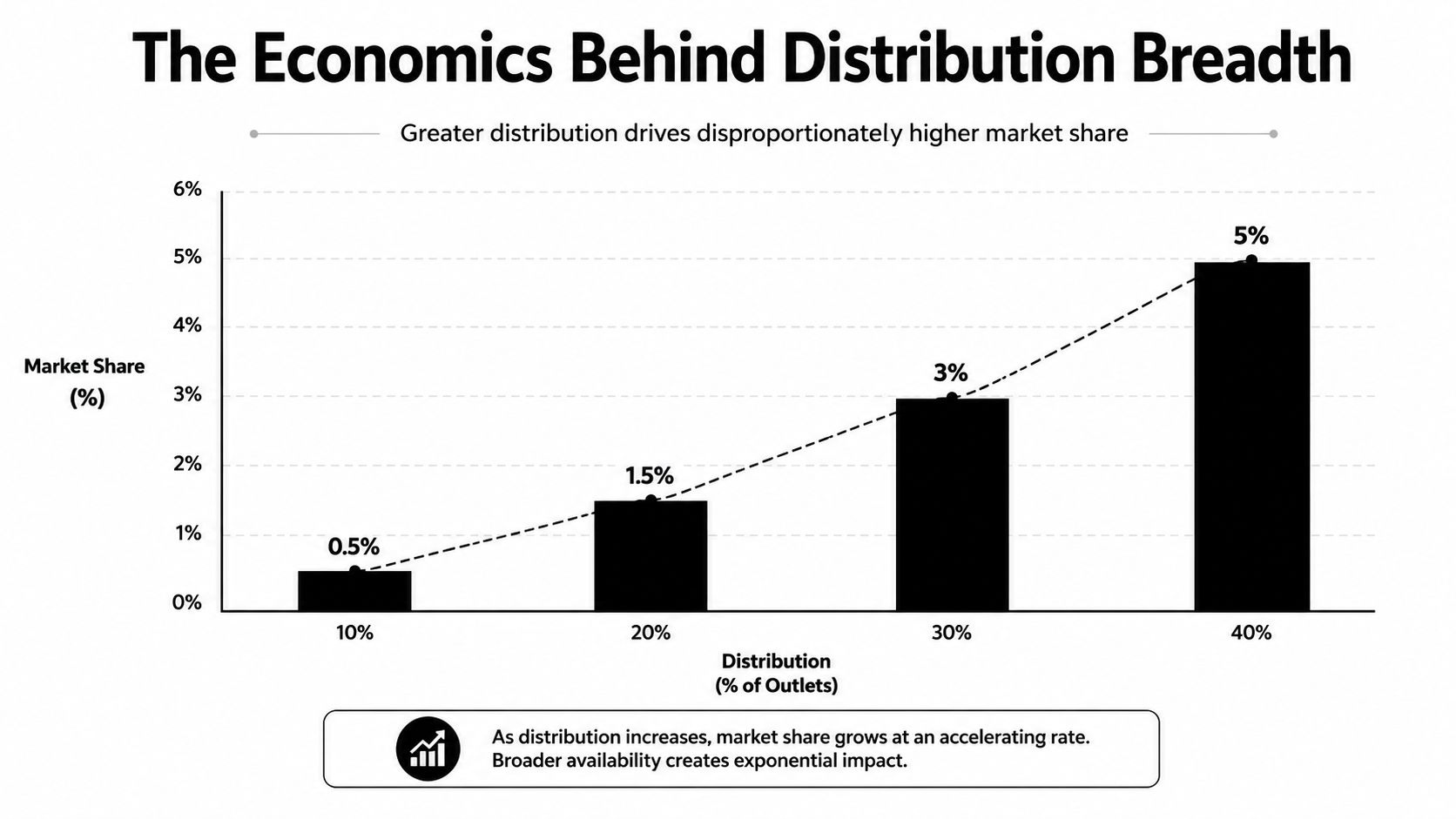
The advantage compounds once a product earns broader availability. A widely cited retail economics study found an increasing and convex relationship between retail distribution and market share in 86% of product categories at the SKU level, using %ACV, or percent all commodities volume, as the measure of retail coverage. The relationship means each additional point of distribution tended to generate more sales than the previous point, rather than producing a flat, linear result. The original distribution and market share study explains why a brand with broad availability can gain more from a new listing than a narrowly distributed brand gains from the same opportunity.
Availability creates commercial momentum
More availability gives shoppers more chances to encounter a product, but it also gives buyers more evidence. A supplier with sales across several relevant channels can show that the assortment works in different shopping contexts. That evidence can make the next conversation easier, especially when the brand can connect retail placement to dependable fulfillment and clear product data.
Channel expansion should still be selective. A product vendor doesn’t need every possible account. It needs the right combination of retailers, category fit, shopper reach, and operating requirements.
For founders evaluating options, a practical guide to multi-platform selling from Million Dollar Sellers offers useful context on why brands often need more than one route to market. Platforms such as BuyersConnect.AI represent one modern route to direct access, matching product vendors with verified retail buyers rather than relying only on passive discovery.
Practical rule: Treat each retail listing as an operating commitment, not just a logo for the website. The account only strengthens distribution market advantage when the supplier can keep the product available, profitable, and easy for the retailer to manage.
The Economics Behind Distribution Breadth
Distribution scale has created an advantage for far longer than digital retail has existed. Historical analysis of supermarket evolution found that chain stores benefited from lower transportation costs, larger networks, quantity discounts, stronger demand forecasting, and more effective inventory planning. Independent price studies from the late 1920s and early 1930s found chain-store prices 4.5% to 14% lower than those of independent rivals, according to the historical analysis of supermarket evolution.
That history matters because distribution breadth improves more than sales reach. A larger network can help a retailer or supplier spread logistics and planning capabilities across more locations. Lower operating costs can support sharper pricing, which can create more shopper demand, which can make additional placement easier to justify.
Modern SKU-level research shows the same structural pattern. A census covering more than 79,000 SKUs across 37 CPG categories with $55 billion in annual revenue found that the distribution and market share relationship was increasing and convex in 86% of categories. The large-scale SKU distribution analysis also found that the effect became stronger in higher-revenue and more concentrated categories, and that the pattern generally held for new SKUs within an existing brand portfolio.
Why the curve changes the launch plan
A linear launch plan assumes that each new retailer contributes roughly the same value. The evidence points to a more complicated reality. A product moving from limited availability toward meaningful retail coverage may gain momentum as buyers and shoppers encounter it more consistently.
That doesn’t mean every listing deserves acceptance. Poor-fit distribution can create costly inventory, service failures, and weak sell-through. The better approach is to prioritize accounts where the category, shopper, pack architecture, price, and fulfillment model reinforce one another.
For an emerging brand, the operating question becomes clear:
- Identify the base: Understand the product’s current retail coverage and the channels producing the strongest response.
- Prioritize compatible doors: Focus buyer outreach where the product solves a real assortment need.
- Prepare for scale: Confirm manufacturing, logistics, data, and cash-flow capacity before broadening placement.
- Measure incremental value: Track whether each new account strengthens velocity, margin, learning, or retailer credibility.
Distribution market advantage grows when breadth and execution improve together. More doors without operational control can weaken the very position a supplier is trying to build.
Core Levers That Build Distribution Advantage
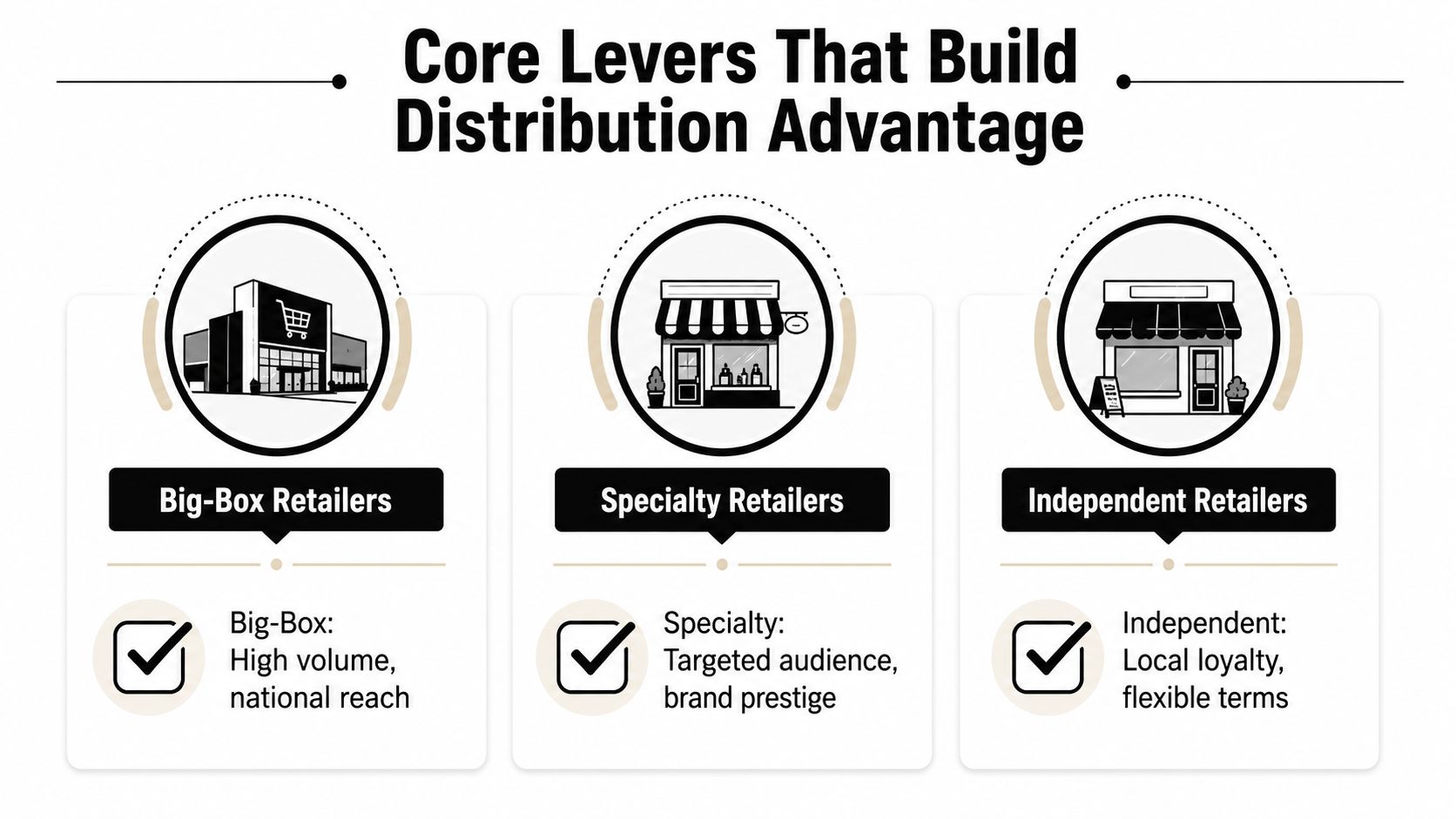
Retail breadth rarely comes from one channel. Big-box retailers can offer high volume and broad reach, specialty stores can provide sharper audience alignment, and independent retailers can create local credibility with more flexible commercial conversations. A balanced channel mix gives a supplier more than reach. It creates multiple ways to learn what shoppers respond to and where the product earns repeat demand.
Start with channel roles
Each channel should have a defined job. A large chain may support volume, a specialty retailer may validate premium positioning, and an independent account may reveal local merchandising insights. The mix shouldn’t become a collection of disconnected experiments. Product vendors should decide which channel supports awareness, which supports margin, and which generates the feedback needed for expansion.
The assortment itself also changes performance. A large-scale study found that larger pack sizes, private label status, and medium price points produced market share above the benchmark predicted by distribution alone. The Monash analysis of SKU performance and distribution shows why the same retail coverage can produce different outcomes depending on price-pack architecture and category demand.
A practical audit should examine:
- Pack structure: Does the pack size suit the shopping mission and expected usage?
- Price position: Does the price make sense beside comparable products?
- Retail margin: Can the retailer earn enough while the supplier preserves a workable contribution?
- Assortment logic: Does each SKU add a clear role, or does it create unnecessary complexity?
Remove friction before the buyer meeting
Category buyers also assess how much work a supplier will create. Clear product specifications, current certifications, dependable case-pack information, compliant labels, and realistic lead times make an offer easier to evaluate. Speed to shelf depends on preparation long before a purchase order arrives.
The product story should therefore sit beside an operational story. A buyer needs to understand who the product serves, where it fits, how it ships, and what support the supplier can provide when the assortment expands.
The video below offers an additional visual explanation of retail channel strategy.
Suppliers can also make buyer access more systematic through active matching tools. Vendor registration for BuyersConnect.AI is one example of a workflow designed to connect product information with relevant retail buyer demand. It should complement, not replace, strong product economics and fulfillment readiness.
Execution Quality as the Modern Moat
More retail doors don’t automatically create a stronger business. A supplier can win placement and still lose the account through late shipments, inaccurate catalog data, weak forecasting, or inconsistent in-stock performance. Buyers remember the operational burden attached to a product, especially when the assortment runs across stores, ecommerce, fulfillment centers, and marketplace workflows.
McKinsey’s analysis of omnichannel competition argues that once omnichannel presence becomes an expectation, differentiation shifts toward dependable execution and transparency. That changes the central question for product vendors. Instead of asking only how to secure distribution, they need to ask whether they can sustain profitable, reliable distribution across channels with different service expectations.
Build the operating layer before expansion
Retail onboarding can require standardized electronic data exchange, catalog testing, and transaction discipline. The U.S. General Services Administration describes an onboarding process that includes an EDI kickoff, testing, and a test catalog, with the 850 Purchase Order transaction set created for each order transmitted to the vendor. GSA’s electronic data interchange guidance illustrates the practical reality: buyer selection is only one step. Suppliers must also fit the retailer’s information and order-processing environment.
Cash flow creates another pressure point. Wholesale terms can place the burden between shipment and collection on the supplier. A wholesale payment-terms guide defines net 30, net 60, and net 90 as payment due 30, 60, or 90 days after invoicing, while some large retail accounts may extend to net 120, or four months. The guide to wholesale payment terms explains why a purchase order can create a working-capital requirement long before it creates cash.
Operational test: Before accepting a major account, model the inventory, freight, compliance, EDI, returns, and payment timing. A large listing that strains working capital can damage a supplier’s entire channel portfolio.
Logistics deserves the same attention as sales. Suppliers reviewing warehouse layout, replenishment processes, and service-level expectations may find Peak Transport’s distribution logistics overview useful for thinking through the physical side of reliable fulfillment. Execution quality is not glamorous, but it protects the relationships that make distribution market advantage durable.
The Rising Cost of Traditional Buyer Access
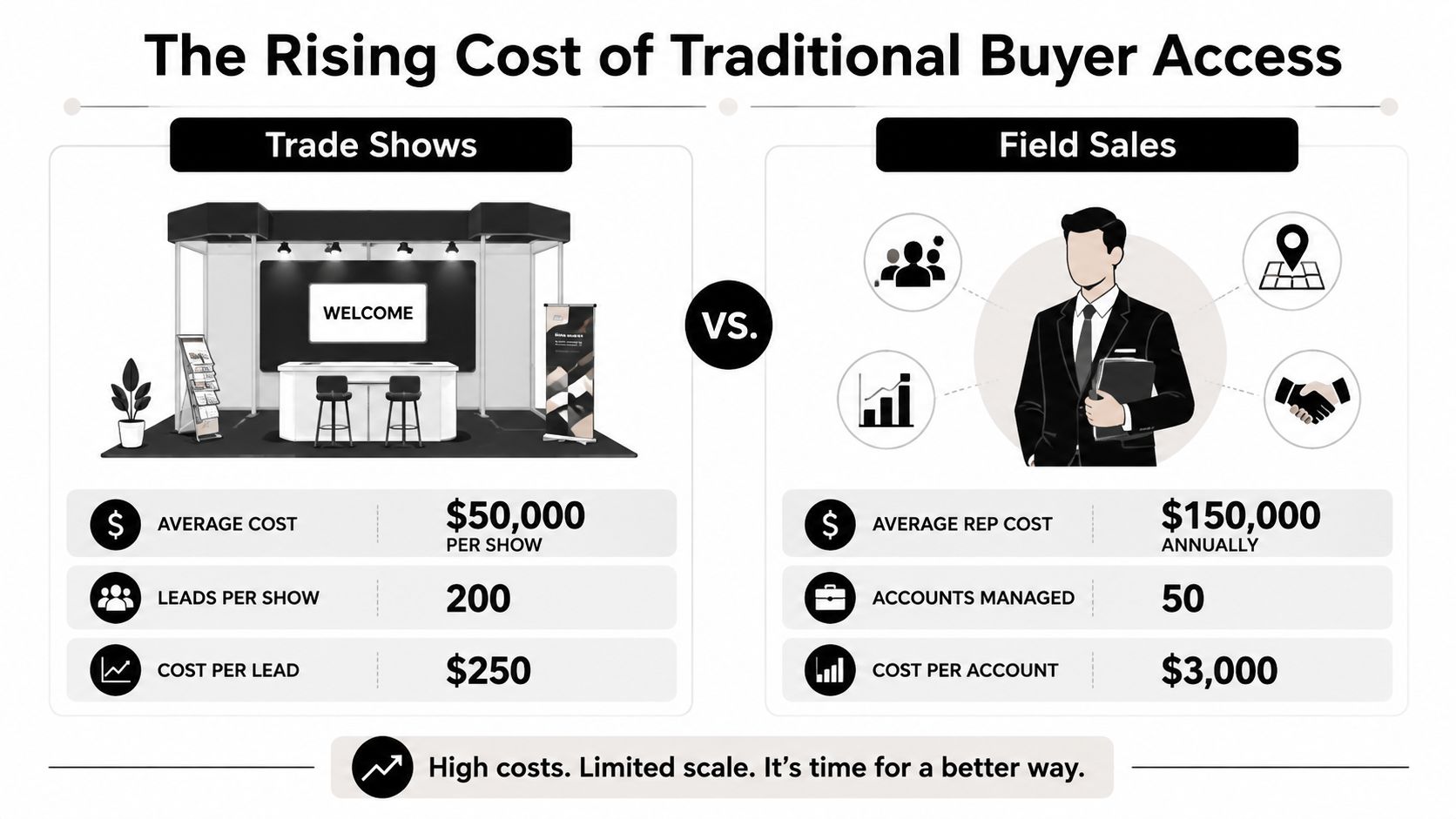
Trade shows still create valuable conversations, especially when a category concentrates its buyers in one place. The problem is that the event budget includes much more than the booth. The U.S. Commercial Service advises vendors to account for airfare, hotels, food, tickets, booth costs, giveaways, transport, and venue fees, and to set ROI benchmarks before attending. Its published trade-show representation fees are $400 for small companies, $950 for medium companies, and $1,350 for large companies. The U.S. Commercial Service trade-show preparation guidance lays out the cost categories suppliers need to plan.
Exhibition inflation makes the calculation harder for smaller brands. The 2025 Annual Survey of Exhibition Rates reported an 18.4% increase in electrical outlet rates and a 9.5% increase in material handling base rates to $2.28 per pound. It also reported that New York exhibition costs were 75% above Atlanta’s cheapest city benchmark. The exhibition rate survey shows how location and venue line items can alter the economics of buyer access before a supplier has a qualified conversation.
Compare access methods by total cost
A trade show concentrates attention, but it also concentrates spending. Field sales can deepen relationships, yet salaries, travel, territory coverage, and account capacity make the model difficult for a small team to scale. Neither approach is automatically wrong. The right choice depends on category economics, buyer density, sales complexity, and the supplier’s ability to follow up.
Government support programs reveal the full event burden. Montana’s Trade Show Assistance Program reimburses 50% of qualified expenses up to $2,500, offers a travel stipend up to $500, and sets a maximum reimbursement of $3,000 including bonus amounts. Its eligible costs include booth rental, equipment, utilities, promotional materials, shipping, storage, drayage, show labor, airfare, mileage, and hotel expenses. Montana’s trade-show assistance program provides a useful checklist even for suppliers that don’t qualify for the program.
AI-powered retail matching adds a different path. Instead of waiting for a show calendar or funding a broad field territory, a product vendor can use active matching to present catalog details to verified buyers whose category needs align with the offer. It doesn’t eliminate the need for samples, negotiation, or operational readiness. It can lower the cost of reaching relevant buyers and help conversations begin in days, not months.
Defending Your Advantage Once You Earn It
Winning placement is the midpoint, not the finish line. Retailers keep products that sell at an acceptable rate, arrive reliably, fit the category plan, and give the buyer confidence that the supplier will respond when conditions change.
The strongest defense combines relationship depth with operating discipline. A vendor should know which SKUs drive velocity, which accounts need a different pack or price position, and which products deserve expansion within an existing relationship. Line extensions can create a logical next conversation when they solve a clear assortment gap rather than just adding complexity.
Turn account data into decisions
A practical review rhythm should connect commercial and operational signals:
- Review velocity: Identify which products move consistently by account and channel.
- Check availability: Investigate stock gaps before a buyer interprets them as weak demand.
- Gather direct feedback: Ask category buyers what shoppers request, what packaging creates friction, and where the assortment feels incomplete.
- Adjust selectively: Change pack sizes, pricing, presentation, or replenishment plans only when the evidence supports the move.
- Protect relationships: Give buyers early notice about supply constraints, product changes, and realistic recovery dates.
The defensible advantage is not the listing itself. It’s the supplier’s ability to make the listing perform repeatedly.
Buyer access also deserves ongoing investment. A brand that relies on one event, one agency, or one relationship carries unnecessary concentration risk. Active matching can help create a broader pipeline, while direct conversations preserve ownership of the commercial relationship and reduce dependence on intermediaries.
Distribution market advantage becomes a moat when the brand keeps learning faster than competitors, serves retailers with less friction, and expands through accounts that already understand the product’s value. The aim isn’t maximum reach at any cost. It’s profitable reach that the supplier can defend.
BuyersConnect.AI offers product vendors an AI-powered way to connect with verified retail buyers through active matching, giving brands a direct path to relevant conversations without relying solely on trade shows or sales agencies. For suppliers building distribution market advantage, Buyers Connect AI is one practical option to explore when buyer access needs to move in days, not months.